

prep
Open the slab before the resin arrives.
Planetary grinders with dust extraction, set up at our Tracy bench for Stockton crews and serious DIY pros who need a coating-ready profile. Tell us what is stuck to the slab and what is going on top of it, and the machine leaves with diamonds chosen for that concrete. Most crews grab it on the same run as their material.
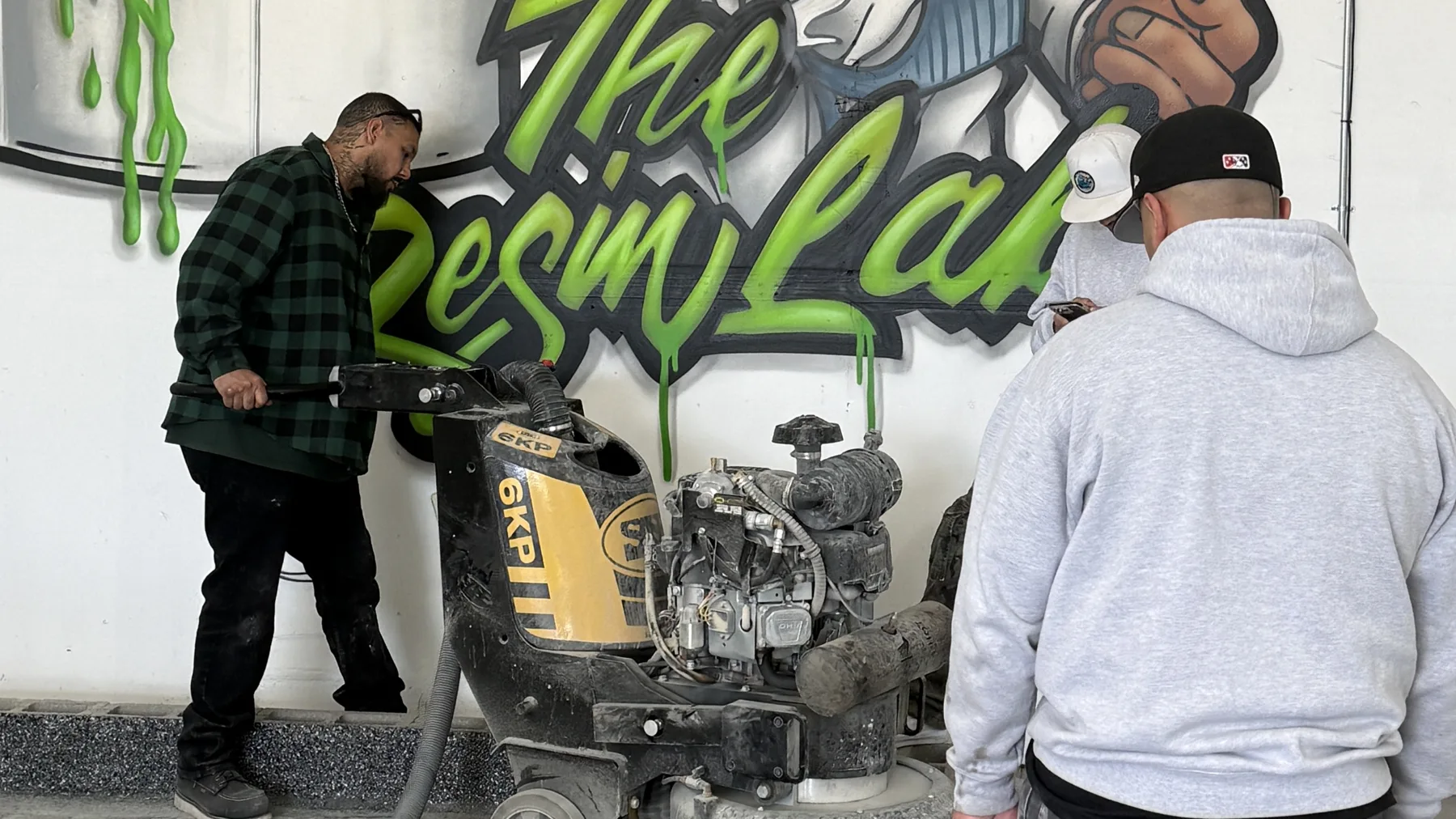
Rent the first few floors, buy once the calendar fills.
A crew starting out in Stockton usually asks whether to buy a grinder right away. Our honest answer is to rent through your first handful of jobs. A planetary machine, an extractor that can keep up with it, and a stock of diamonds for different slabs add up to a serious commitment, and early on you do not know yet which size machine your work actually calls for.
Renting teaches you that. After a few garages and a shop floor or two, you will know whether you mostly grind two-car garages or bigger commercial spaces, how often you run into hard troweled concrete, and whether an owned machine would sit in the trailer more days than it runs. Those answers pick the right purchase for you.
Owning starts to make sense when grinding shows up on your schedule most weeks and you are ready to take on storage, maintenance and tooling. Until then, let the bench carry the machine. When you are ready to talk about buying, call and ask. Contractors who order regularly get set up with terms.
Rent until the machine would be busy most weeks.
Silica is the part of the grind you cannot see.

Grinding concrete throws crystalline silica, and the particles that do the damage are small enough to hang in the air long after the visible dust settles. That is why an extractor rides out with the grinder every time, and why the shroud needs to stay seated on the floor the whole time you are cutting.
A few habits keep it working. Bag or empty the extractor before it fills, since suction drops well before the canister looks packed. Check the shroud skirt for worn gaps. Wear a properly fitted respirator even with extraction running, and keep anyone who is not grinding out of an enclosed space until the air clears.
The coating benefits too. Dust left sitting in open pores gets trapped under the primer and turns into weak spots you only find once the floor starts to lift. A clean extraction job leaves less to vacuum and a better bond for whatever goes down next.
Soft bond for hard concrete, hard bond for soft.
Metal-bond diamonds cut because the bond wears away and keeps exposing fresh diamond. That is the whole trick, and it runs backward from what most people guess. A hard, dense slab that was power troweled needs a softer bond so the matrix keeps breaking down. A soft or sandy slab chews through metal quickly, so it wants a harder bond that lasts.
Get it wrong one way and the segments glaze: the machine hums, the floor turns shiny, and nothing is coming off. Get it wrong the other way and a set of segments disappears in a morning. On a job where nobody knows the slab history, tell us how the concrete looks, whether water beads up or soaks in, and roughly how old the building is. That is enough to pick a starting bond.
Do a scratch test before you roll the machine off the trailer. A masonry nail dragged across the surface tells you a lot about how hard it is. If the first pass behaves differently than expected, stop and call the bench before you burn through tooling you never needed to use.
Glue, thinset and old coatings come off first.
Plenty of Stockton floors show up with something already stuck to them. Carpet glue, black mastic from old tile, thinset ridges left after a demo, a garage coating peeling up from years ago. None of it can stay under a new system, and a planetary grinder is only the right tool for part of that work.
Thick thinset and heavy tile residue come down faster with a scraper or chisel before the grinder ever touches them. Soft adhesives gum up diamonds in a hurry, so those jobs want aggressive segments made for removal and a lot of patience emptying the extractor. Old black mastic can contain asbestos, so have it tested before anyone grinds it.
A thin, well-bonded old coating can sometimes be ground and recoated. A thick or failing one should come off completely. If you are not sure which you have, send a photo of the worst area when you call. Crack chasers, patch material and edge tooling live on the tooling and prep shelf and can go out with the machine.
Test old mastic before the diamonds touch it.
Hold a CSP chip against the floor before you mix.
The profile target for most resinous systems sits around CSP 2 to CSP 3. A set of CSP reference chips turns that from a guess into a side-by-side comparison, and the whole check takes about as long as a coffee break.
Vacuum a test area bare
Pick a spot away from the walls where the machine made normal passes, and get every bit of dust off it. Dust fills the pores and makes a profile look smoother than it really is.
Lay the chips down in raking light
Set the reference chips on the floor and put a light low off to one side. Compare the texture by eye first, then by fingertip, down at slab level where the differences show.
Check the edges and the burnished spots
The middle of the room is rarely the problem. Look along the walls, around posts, and anywhere the slab still has a gloss to it. Those areas usually need hand tooling or one more pass.
Match it to the system going down
A thin coating and a quartz broadcast system do not want the same profile. Confirm the target on the data sheet for your product, or call the bench and ask before you open a kit.
Grinder questions from Stockton crews.
What should I tell you before I pick up a grinder?
The square footage, what is on the slab now, roughly how old the concrete is, and which coating goes down afterward. That is enough for us to size the machine, choose a starting diamond bond, and have the extractor and hoses staged at the Tracy bench when you arrive.
Can one grinder handle a garage and a big shop floor?
It can, though it is not always the smart choice. A smaller machine is easier to load and gets around a two-car garage without a fight. A large shop floor goes faster with more machine behind the heads. Tell us about both jobs and we will say which fits.
Is the dust extractor really necessary for a small garage?
Yes. A small, enclosed garage is where dust builds up fastest, and concrete dust carries silica you do not want in your lungs or trapped under the coating. Run the extractor, keep the shroud down on the floor, and wear a fitted respirator the entire time you grind.
Will the grinder take up tile adhesive and old coatings?
With the right segments it can remove many adhesives and thin coatings, though heavy thinset is quicker to scrape down first. Old black mastic should be tested for asbestos before anyone grinds it. Describe what is on the floor when you call and we will set you up for it.
How do I know the slab is ready for coating?
Vacuum a test area, compare it against CSP reference chips in low raking light, and confirm the pores are open across the whole floor, edges included. Any glossy patches need another pass. Then match the final profile to the data sheet for the coating you bought.
Should I buy a grinder instead of renting one?
Rent through your first several jobs. Once you know what size machine your work calls for and grinding is on the calendar most weeks, owning starts to make sense. Contractors who order from us regularly can set up terms, so call the bench and talk it through.
Picking up the grinder and what rides with it.
Stockton sits about 22 road miles from our Tracy bench, one of the markets we supply across San Joaquin County. That distance makes it easy to grab the grinder in the morning and the coating on the same trip, and most material orders go out the same week.
Crews usually put the grind and the system on one order: epoxy systems, polyaspartic topcoats, decorative flake or metallic flooring.
Machine details live on the concrete grinder rental page. The Stockton supply page covers the rest of the shelf, the catalog lists the diamonds and consumables, and the wider county starts at San Joaquin County.
Send the slab details and your dates.
Give us the age of the slab, what is on it now, and the days you need the machine.
- (209) 208-4656
- chris@exclusiveresins.com
- Tracy, CA · Ships nationwide
Stockton slab waiting on a grind?
Call the bench with the square footage and whatever is stuck to the floor, or send a message and we will stage the grinder, extractor and diamonds for your pickup.