

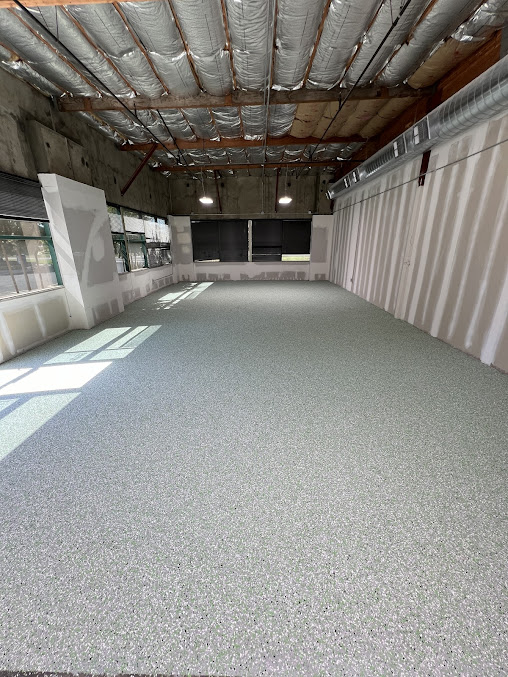
epoxy
Spec the big room as one system.
Primer, body coat and topcoat for a Lathrop shop, showroom or open commercial space, worked out together at the Tracy bench. Your crew pours it. We make sure the last kit is sitting there when the squeegee reaches the far wall.
big floors
Open rooms punish a piecemeal order.
A two-car garage forgives a sloppy order. If the base comes up short, somebody drives to Tracy and back while the first coat is still green. A Lathrop shop floor or a long commercial room gives you none of that slack. The crew is spread out across the slab, and once a squeegee line starts moving it has to keep moving until it meets a wall.
So the order has to look different. A bigger floor needs quantities worked out coat by coat, kits sized to what the crew can mix and lay inside one working window, and enough of every product on site that nobody is guessing at the far end of the room. Buy the primer from one counter, the body coat from another and a clear from whoever had it in stock, and you now own three products nobody has ever put down together.
The owner put each of these products down on an actual job before we agreed to stock it. When you call about a large room, the conversation starts with the room, the traffic and the slab, and works backward to the buckets.
A long room gives you no second trip.
Primer, body and wear layer share one label.
Write the whole system on one sheet before you order any part of it. Each coat has its own job, and each one leans on the coat below.
The notch on the blade sets your coverage.
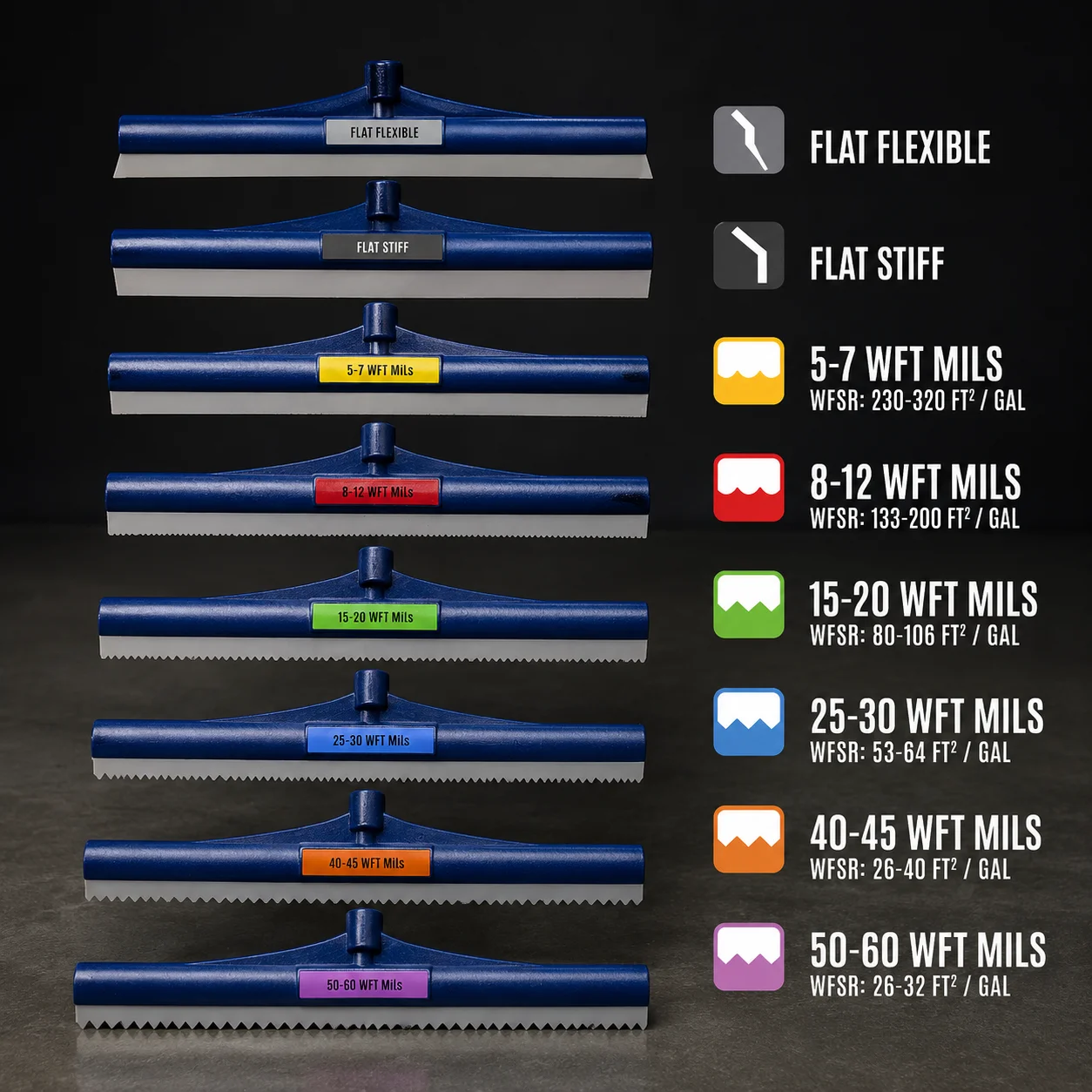
On a big pour, nobody judges thickness by eye. The notched squeegee does it for you. Each notch size leaves a known wet film thickness in mils behind the blade, and that thickness against the square footage tells you how many gallons a coat will use. Pick the blade first, do the division second, and the order nearly writes itself.
The chart beside this is the one we hand to crews. Flat flexible and flat stiff blades sit at the top for thin work like primer. Below them, the notched blades step up by wet film thickness, each with its coverage range per gallon printed next to it. Match a blade to each coat and you can tell a Lathrop client how much material the room takes before anyone cracks a lid.
Two cautions from the bench. A worn notch lays less film than its label claims, so put fresh blades on before a large job. And a back-roller only evens out what the squeegee left; it adds nothing, so a thin pass stays thin however good the roller finish looks.
Stage every kit before the first one opens.
Running out mid pour is the costliest mistake on a large floor. Material stops, a wet edge sits and skins, and the seam where the next batch meets the last one shows for as long as the floor exists. The fix happens days earlier, when the order gets written.
Count kits for each coat from the blade math, then round up to whole kits. Add margin on the primer for an open, thirsty slab, and more for edges, corners and column bases, which always take more than their share. Line the kits up by coat along the wall at the starting end, in mixing order, so the mixer never walks the room hunting for the next one.
Then set the roles. One person mixes, one or two pull material with the notched blade, and one back-rolls behind them. On a long room the mixer’s pace is the pace of the whole pour, so if that person can only stay ahead with smaller kits, order smaller kits.
Pickup keeps this simple. Let us know ahead of time and the full order gets pulled and grouped by coat at the Tracy bench before your truck pulls in. Crews who buy regularly should ask about contractor pricing and terms.
A damp slab gets its barrier first.
Epoxy laid over a slab pushing moisture vapor can blister or lose its grip, and in a big room that failure covers a lot of floor before anyone notices. The risk runs highest on older slabs with no vapor retarder beneath them and on floors whose edges stay dark and cool long after the middle has dried.
Test before you spec. If the results come back high, a moisture mitigation layer goes down first and the rest of the stack goes over it. That is one more line on the order and one more coat on the schedule. Learning it before the pour costs a phone call. Learning it afterward means grinding a failed floor back to bare concrete.
Send us the test results and whatever slab history you have, and we will tell you whether a barrier belongs in the stack and which one suits the system you plan to run.
Other Lathrop lines off the same shelf.
An epoxy body is usually one piece of a bigger order. Here is what tends to ride along with it.
Big-floor epoxy questions.
How do I size epoxy for a large open room?
Measure the real square footage, pick a notched blade for each coat, and read coverage per gallon off the blade chart. Divide, round up to whole kits, and add margin for primer on a thirsty slab. Call the bench and we will check the math with you.
Why buy the primer, body coat and topcoat together?
The three coats have to bond to each other and cure on a shared schedule. A stack the owner has already poured together behaves predictably on the slab. Mixing brands coat by coat adds variables you only discover once the floor is down and the crew has gone home.
What wet film thickness should the body coat go on at?
That depends on the product and on what the room has to survive. Tell us the traffic, the equipment and how the floor gets cleaned, and we will match a notched blade to the body coat so the film thickness and the gallon count agree.
Does every Lathrop slab need a moisture barrier?
No. Plenty of slabs test fine and go straight to primer. Test first anyway. If the results come back high, the barrier goes down before anything else, and we will add it to the kit count so it never gets left off the order.
Can a large order be staged for pickup in Tracy?
Yes. Lathrop is about 8 road miles from the bench. Let us know ahead of time and we will pull every kit and group it by coat, so loading the truck goes fast and nothing gets left sitting on the shelf.
Will your crew pour the floor in Lathrop?
No. Exclusive Resin Supply is a Tracy shop and training academy. We sell the material, spec the stack and teach the systems, and you or your crew lay the floor. Every system we sell has been poured by the owner on a real job first.
Pick it up grouped by coat.
A Lathrop crew can swing by the Tracy bench for a staged order and still reach the slab before the morning gets away. We are members of the Lathrop Chamber of Commerce and sponsor Lathrop Little League and the Junior Spartans, so plenty of the people ordering from us are neighbors.
The Lathrop supply page covers the rest of the shelf, and the county page lists the towns nearby.
Describe the room before you order.
Send the square footage, what crosses the floor and anything you know about the slab. You will hear back from someone who has poured these systems.
- (209) 208-4656
- chris@exclusiveresins.com
- Tracy, CA · Ships nationwide
Specifying a large floor in Lathrop?
Call the bench with the room size, the traffic and your moisture results. We will build the kit list coat by coat and have it staged in Tracy.