

A pool deck is the hardest surface a resin system gets asked to do in this part of California. It is wet, it is barefoot, it is in direct sun from June through September, and the client will judge it with the soles of their feet before they ever judge it with their eyes. Flake will not survive that assignment. Quartz will, and the reason comes down to three things: the aggregate, the resin over it, and how much sun the finish is asked to eat.
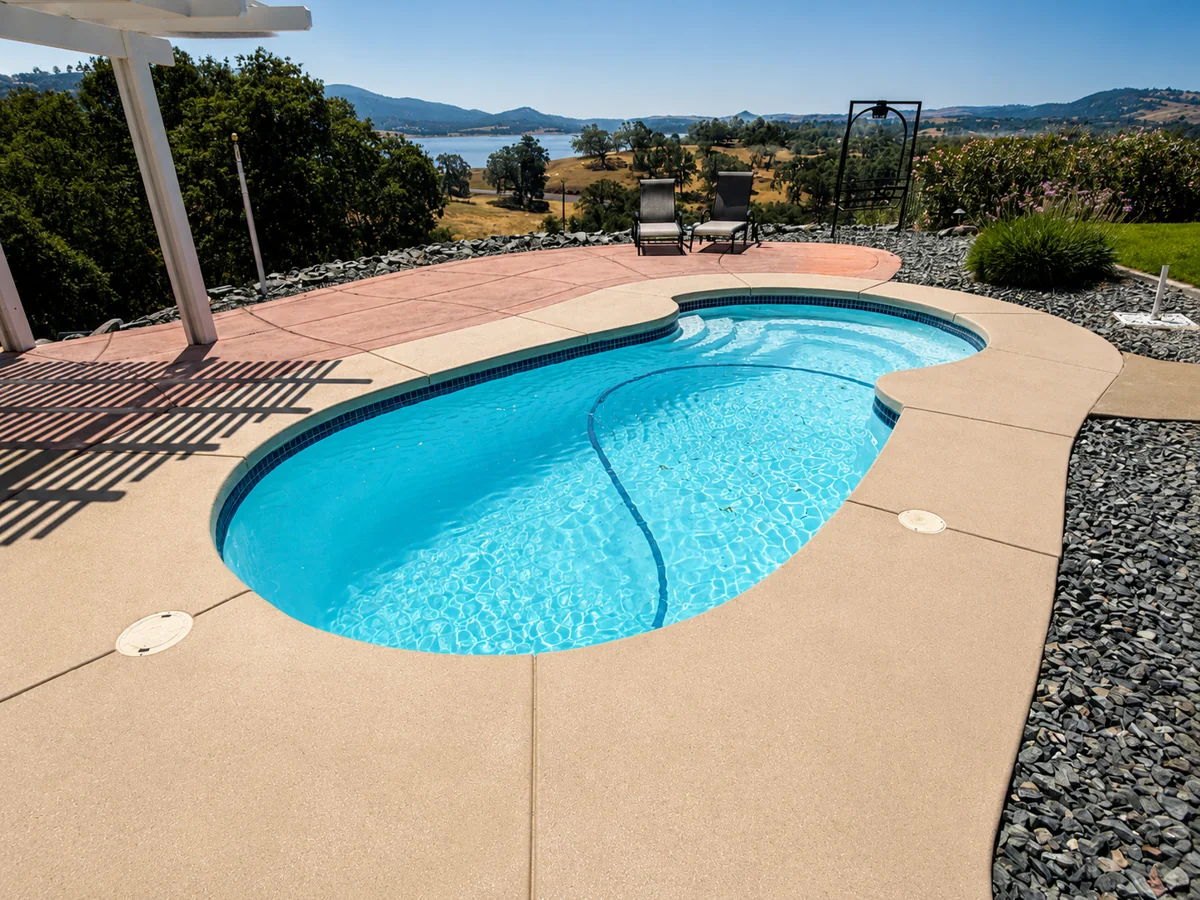
Why quartz and not flake out here
Decorative flake is a vinyl chip. It is thin, it lies flat, and once it is scraped and buried in clear the surface it produces is essentially smooth with a faint texture. On a garage floor that is exactly right. Around water it is the wrong surface, because smooth and wet is how somebody ends up in the hospital.
Quartz is kiln dried sand, a hard rounded aggregate with real dimension to it, broadcast into a resin base until the surface will not take any more. What you get is a genuinely textured floor with grip that comes from the shape of the deck rather than from an additive sprinkled into a topcoat. That texture does not wear off, because it is not a coating feature, it is the aggregate itself sitting proud of the resin.
The second difference is thickness. A quartz broadcast system builds considerably more film than a flake garage floor, and that mass matters on a deck that expands and contracts in sun and gets hammered by furniture, coolers and pool equipment. It is closer to a thin mortar than to a paint.
The third is the aggregate itself. Kiln dried quartz is colored by a pigment fused to the grain, not by a dye sitting on it, which is why quartz decks hold their color under California sun far better than most decorative alternatives.
Texture you can walk on barefoot
Here is where crews get it wrong in both directions. Too little texture and the deck is slick when wet. Too much and it is a cheese grater that nobody wants to stand on in bare feet, and the client will tell you about it for years.
Grain size is the main lever. Finer quartz produces a tighter, gentler texture that still grips wet; coarser quartz produces aggressive grip with a harsher feel. For a residential pool deck where people are barefoot all summer, the fine and medium end is where you want to live. For a commercial wet area, a kitchen, a locker room, a wash down bay, coarser is appropriate because everyone is in shoes.
The topcoat decides the rest. A quartz broadcast can be finished with a full grout coat, where the topcoat floods the aggregate and levels the surface into something smooth and easy to clean, or with a lighter finish that leaves more of the grain standing proud. More flood coat means smoother and slicker. Less means more grip and more texture for dirt to sit in.
The practical middle ground for a deck: broadcast to rejection, sweep and vacuum off everything loose, then finish so the aggregate is locked but not drowned. Make a sample board and walk on it wet in bare feet before you commit the whole deck. That is a ten minute test that settles an argument you cannot settle with a data sheet.
Cool touch, and what actually drives it
Every client with a pool asks whether the deck will burn their feet. It is a fair question in a place that spends most of July over a hundred degrees, and the honest answer has more to do with color than with chemistry.
Surface temperature in the sun is driven mostly by how much light the surface absorbs. A light colored deck, tans, creams, pale grays, reflects a large share of it and stays notably cooler than a dark one. A dark gray or charcoal quartz deck in direct Valley sun gets hot enough that nobody crosses it barefoot at two in the afternoon. That is not a product failure, it is physics, and it is the single most important thing to tell a client before they pick a color they saw in a photograph taken in Seattle.
Texture helps a little too. A textured surface has more area shedding heat and less continuous contact with the sole of a foot than a smooth one, so the same color reads slightly cooler in a broadcast finish than in a flat coating.
Gloss level matters for comfort in a different way. A high gloss deck in full sun produces real glare off the water side, and around a pool that is unpleasant. A satin or matte finish is easier on the eyes and hides water spotting between cleanings.

The sun, and choosing a topcoat that survives it
Whatever goes on top is the layer taking the ultraviolet, and that rules out a lot of options for an outdoor deck.
Standard epoxy is not UV stable. In sun it ambers, going progressively yellow, and it chalks, developing a dull powdery surface as the resin at the top breaks down. Indoors that never comes up. On an exposed pool deck it will be visible within a season. Epoxy still has a place in the system as a body coat underneath, where it is protected, but it should not be the layer facing the sky.
Aliphatic polyaspartic and urethane topcoats are what belong on the exposed face. They hold color and gloss under ultraviolet in a way epoxy simply does not, and the fast cure is a genuine advantage on an exterior deck where you are racing weather and temperature swings rather than working in a controlled garage.
Temperature is the operational catch. Working time on a fast topcoat drops sharply as it gets hotter, and an exterior slab in direct Valley sun in the afternoon is far above air temperature. Work the deck in sections, start at dawn, and keep the material out of the sun until the moment it goes into the mixer. On an exterior pour, shade and an early start are worth more than any additive.
Ordering a pool deck system for a Manteca job
A quartz deck is emphatically a system rather than a product, and it is the sort of order where getting the stack right on the first pallet decides whether the job is a good week or a bad one. A primer suited to the slab, the base resin the quartz goes into, the quartz itself in the grain and color the client picked, and a UV stable topcoat. Every one of those has to be compatible with the one under it.
Quantities are where people get surprised. Broadcasting to rejection consumes a lot more aggregate than the arithmetic suggests, because you are deliberately throwing more than the resin can hold and sweeping the surplus back up. Budget for surplus rather than for the theoretical number, and order the whole deck from one lot so the color is consistent across it.
Exterior work also puts the slab itself back in the conversation. An exterior deck moves, and expansion joints have to be honored through the system rather than coated over, or they will telegraph a crack up through your new floor by the second summer.
We spec these regularly, and the quartz broadcast page covers the line itself. For anyone working a deck in Manteca, the Tracy bench is about 12 road miles away, which means the primer you forgot is a morning errand rather than a lost weekend.
Pool deck questions from the counter
Will a quartz pool deck be too hot to walk on in summer?
That depends almost entirely on the color you pick. Light tans, creams and pale grays reflect most of the sunlight and stay far cooler underfoot than a charcoal deck, which in direct Valley sun in the afternoon gets hot enough that nobody crosses it barefoot. Texture helps a little as well. Choose the color for the heat first and the look second.
Can I use an epoxy topcoat outside if I like the gloss?
Not as the exposed layer. Standard epoxy ambers and chalks under ultraviolet, and on a deck in full sun that shows within a season. Keep epoxy as a body coat underneath where it is protected and finish with an aliphatic polyaspartic or urethane that holds color and gloss in sunlight.
How much grip is right around a pool?
Enough to be secure wet, gentle enough for bare feet. That usually means a fine to medium quartz grain finished so the aggregate is locked but not drowned in topcoat. Coarse grain belongs in commercial wet areas where everyone wears shoes. Make a sample board and walk it wet barefoot before you commit the deck.
Exterior work punishes a guess, so it is the kind of job worth talking through before anything ships. Call the bench at (209) 208-4656 with the deck square footage, the color the client is leaning toward and which way it faces, or send the details over and we will spec the whole stack with you.