

First flake jobs go wrong in a small number of ways, and they are almost never chemistry. They are timing, body position and the decision to be careful at a moment when the job calls for speed. Everyone who pours flake for a living got these wrong once. The useful thing is that each one has a tell you can spot before the floor is ruined, and a fix you can apply while the base coat is still open.
Throwing flake too gently
The instinct on a first job is to place the flake carefully, low and close, because it feels like precision. It produces the worst looking floor of any single mistake in this trade.
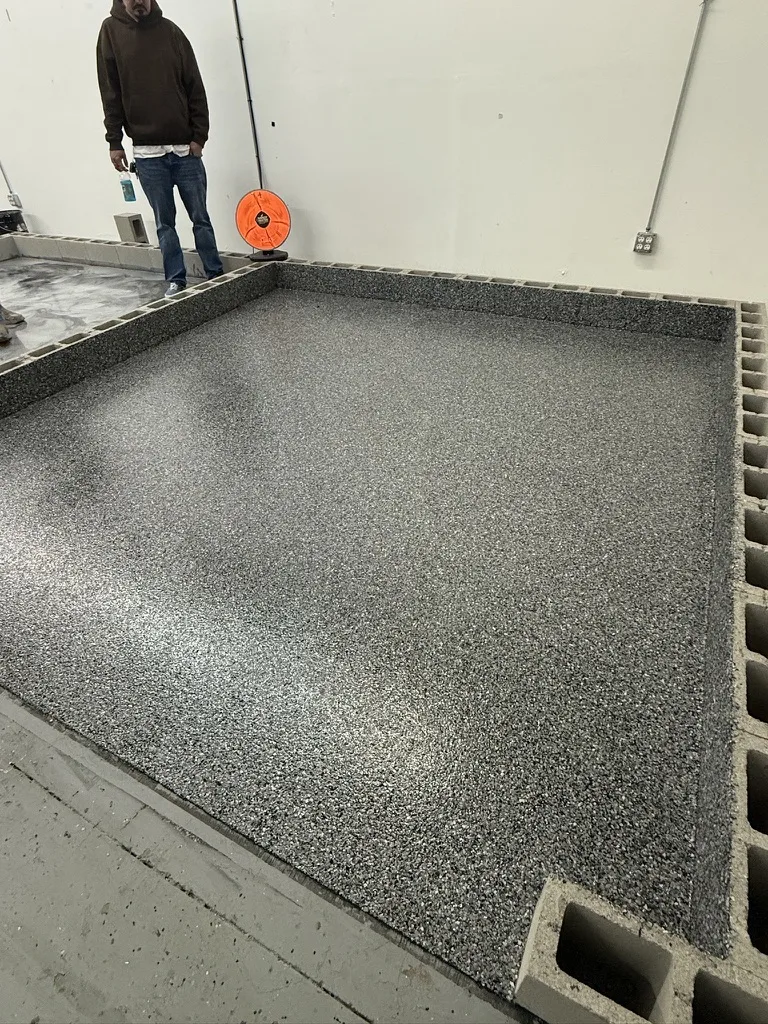
Flake thrown low lands in a dense clump with a visible edge, and every one of those edges is a seam you can see forever under a clear coat. Flake thrown hard and high goes up, separates in the air, and comes down randomly. Random is what you want, because random has no pattern and therefore no seams.
The motion is an underhand toss up toward the ceiling, not a scatter at the floor. You are aiming to fill the air above the section and let gravity deliver it. On a garage with a normal ceiling you throw up into the space and walk backward through the falling field.
The tell is on the floor while you work: if you can see where one handful landed and the next began, you are throwing too low. Fix it immediately by going higher and lighter per throw, and keep moving over the boundary until the density evens out. A partial broadcast is far less forgiving here than a full one, because a full broadcast packs to rejection and buries the evidence.
Broadcasting the wrong distance behind the base coat
Flake has to go into wet resin, and the window is narrower than beginners expect, especially in a Manteca garage in warm weather.
Too far behind and the base coat has started to set. The chips sit on a skinned surface instead of sinking into it, and they let go later, usually in strips as the topcoat delaminates with them. Too close and you are broadcasting into resin somebody is still rolling, which means you walk into your own wet base.
The working distance is roughly one section back. One person rolls a manageable strip, the broadcaster follows behind that strip while it is still visibly wet, and the roller has already moved on to the next strip. The two of you keep a fixed gap and move together, like a two person conveyor.
The tell is the sheen. A wet base coat is glossy and uniform. When it starts to dull or go matte at the leading edge, the window is closing and you are behind. In heat that happens fast enough that the fix is not throwing faster, it is rolling smaller sections so the gap between roll and broadcast shrinks.
The other half of that is the size of the section your crew can actually handle. Work out how much floor one batch covers, time how long it takes to place and broadcast that much, and make sure your pot life is comfortably longer than that number. If it is not, the batches get smaller. Nobody has ever regretted a batch that was too small.
Starting somewhere you cannot finish from
This is the mistake that produces the phone call, because it cannot be fixed at all.
A flake job is walked backward. You are standing in wet resin in spiked shoes, throwing flake into the air, and the whole floor behind you is done and untouchable. If you started at the wrong end you will reach a point where the only path out is across your own floor.
So plan the exit before the first pail opens. Start at the wall farthest from the door and finish at the door. Walk the whole route beforehand, including around any obstacle, a water heater, a post, a step, and confirm you never have to cross a finished area.
Two people make this trickier rather than easier, because now two paths have to work simultaneously without either one boxing the other in. Decide out loud who is where before you start, and agree on where you will both end up.
Decide in advance where you will stop if something goes wrong. A stop at a saw cut or a doorway looks like a design decision. A stop in the middle of an open floor looks like a mistake for the life of the floor.
Skimping on the scrape
After the base cures with flake in it, the surface is sharp. Chips that landed on edge or overlapped stand up out of the film, and they have to come off before anything goes over them.
This step gets rushed because it is unglamorous and because the floor already looks finished. It is not. Unscraped chip edges create a rough surface the topcoat cannot level, they collect dirt, they catch on shoes, and they show as texture and haze in the clear.
Scrape the whole floor with a sharp blade held at a low angle, working in overlapping passes across the entire surface, including the corners and the perimeter where the hand work happened. Then sweep, then vacuum, then vacuum again. Loose chip left on the floor will float in your topcoat and ruin the clarity.
Run a bare hand over the swept floor before the topcoat goes down. It should feel like fine sandpaper and nothing should catch. Anything that catches your palm will catch the client’s attention forever.
Running out of flake in the middle of the floor
Full broadcast means throwing flake until the surface will not accept another chip, then sweeping up what did not stick. Which means you are deliberately throwing far more than lands, and the number people budget for is almost always the number that lands rather than the number that gets thrown.
Running short mid broadcast is unrecoverable in any clean way. The base coat is curing whether or not you have material, and a section that got a thin broadcast will read differently under the clear no matter what you do to it afterward.
So order long. The surplus sweeps up, and on a full broadcast a meaningful share of what you throw is coming back up anyway. Order the whole floor from one lot so the blend is consistent, and have the extra open and within reach rather than sealed in a bag across the garage.
Practically, this is one more argument for buying local. A crew twenty minutes from the Tracy bench can send somebody for a bag mid job. A crew waiting on freight cannot. The flake systems page covers the blends and the coverage side, and for anyone pouring in Manteca the drive over is short enough to make surplus a cheap insurance policy rather than a logistics problem.
First flake job questions
Why does my flake floor have visible clumps and lines in it?
You threw too low and too close. Flake released near the floor lands dense with a visible edge, and those edges never disappear under the clear. Throw underhand up toward the ceiling so the chips separate in the air and fall randomly, and walk backward through the falling field rather than scattering at your feet.
How far behind the base coat should I be broadcasting?
Roughly one section back, with the base coat still visibly glossy. When the leading edge starts to dull, the window is closing and the chips will sit on a skin instead of sinking in. In warm weather the answer is not throwing faster, it is rolling smaller sections so the gap between the roller and the broadcaster stays short.
How much extra flake should I order for a full broadcast?
More than the arithmetic suggests, because full broadcast means throwing until the surface rejects more chip and sweeping the surplus back up. Running short mid floor cannot be fixed cleanly. Order the whole floor from one lot, order long, and have the extra open and within reach before you start.
Every one of these is easier to avoid than to repair, and most of them are settled in one conversation before the job. Call the bench at (209) 208-4656 and walk your first flake floor through with the owner, or send over the square footage and the blend and we will work the coverage and the sequence with you.